
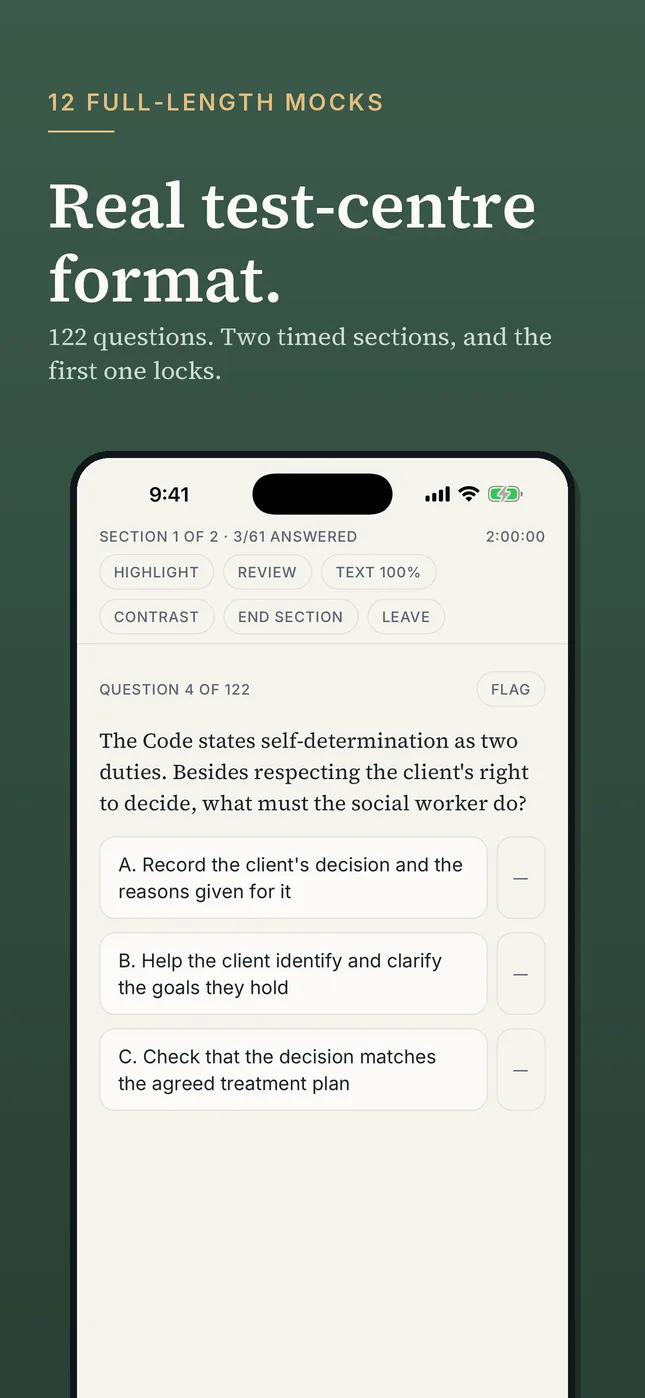
What a full-length ASWB mock looks like on your phone
Each mock is 122 questions in two sections of 61. You get two hours for each section and a scheduled ten-minute break between them, the same allowances as the exam itself. Inside a section you can move around freely, flag questions and change answers. When you submit section one, it locks.
The tools along the top are the ones you will have at the test center: a highlighter, a review screen listing flagged and unanswered questions, text size and a contrast setting. Each option also has a strike-through control, so you can cross out what you have ruled out. On a three-option question, ruling out one option is most of the work.
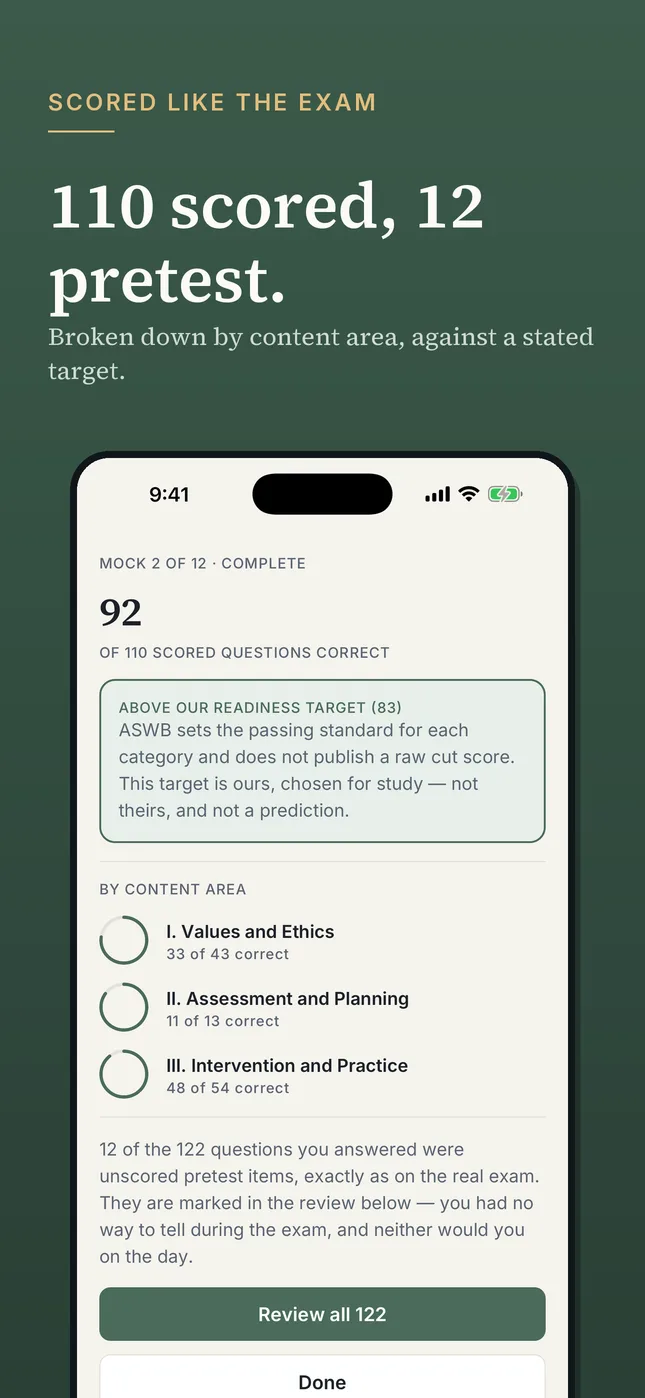
Scored like the real exam, with the pretest items hidden
Twelve of the 122 questions are unscored pretest items, as on the real exam, and nothing tells you which twelve while you are answering. Your result counts the other 110. Afterwards the review marks which ones were pretest, so you can see how much time a question that never counted actually cost you.
The result breaks your score down by the three content areas and compares it with a readiness target. That target is ours, set for study. ASWB sets the passing standard for each category and publishes a range, 66 to 78 correct out of 110, because its exam forms differ slightly in difficulty. No app can tell you your pass mark in advance, and ours says so on the results screen.
Why twelve mocks, and why no repeats
One mock tells you how one sitting went. Scores move by several points between sittings on the same knowledge, because the questions differ and so does your concentration. With a set of mocks you can follow the trend across sittings, and a weak content area tends to show up in the same place three times running, which is when it is worth acting on.
Repeats spoil the trend. If question 40 of your sixth mock is one you met in your second, you are scoring your memory of an answer rather than the reasoning the exam tests. The twelve mocks for each exam share no questions. Between mocks, the practice modes take over: drills of 10, 20 or 40 questions, a three-option drill that trains elimination, and queues of the questions you missed or flagged.
When to sit each mock, and what to do with the result
Sit the first mock once you have covered about half the outline, so that it measures something. After that, one every seven to ten days works for most plans, with the last about a week before your exam: close enough to be a fair reading, and far enough out to act on. Skip full mocks in the final two days. Four hours of testing costs more energy than the result is worth by then.
When a result comes in under target, look at where the marks went before you look at the total. One content area well below the others is a study problem, and drills in that area are the fix. Misses spread evenly, with a cluster on questions that carry FIRST or NEXT, usually point to how you are reading the questions. Time is the third suspect: if you reached the end of a section with nothing left for your flagged questions, the fix is moving on sooner, and more content will not help.
For every miss, write down the content area and one line on why the keyed answer won. After three mocks that list is the most useful study document you own, and the scoring guide explains why the content-area breakdown matters more than the total.
How to sit an ASWB mock exam on your phone
Book four quiet hours. Treat the mock like the real appointment: phone on Do Not Disturb, notifications off, nothing else open. A mock squeezed between other tasks mostly measures your multitasking.
Take the scheduled break and nothing more. Use the ten minutes between sections. On exam day an unscheduled break comes out of your testing time, so practice without one.
Flag and move on. When a question will not resolve in about two minutes, choose your best answer, flag it, and come back to it before you submit the section.
Submit section one deliberately. Open the review screen and clear every unanswered and flagged question first. Once you submit, section one is closed.
Review every question, right or wrong. Read the rationale for each option, including on questions you got right, and note the content area of every miss.
Drill the weakest area before the next mock. Spend the days until the next mock on drills from the content area that lost you the most marks, then sit the next one under the same conditions.
Quick answers
- How many ASWB practice tests should I take before the exam?
- Enough to see a trend, which for most people means three to six full-length mocks spread over the last month or two. Leave a few days between them so you can study what each one shows you before you sit the next.
- Should I also take ASWB's own practice test?
- ASWB sells an official online practice test, and it is a useful last check because it is written in ASWB's own style. It is a single sitting, so it works best near the end, after a set of full-length mocks has already shown you where your weak areas are.