How the Clinical exam differs from the Masters
The Clinical exam has the same shape as the others: 122 questions, 110 of them scored, in two timed sections of 61. The weighting is slightly different. Values and Ethics is 36% of the Clinical exam against 35% on every other category, and Assessment and Planning and Intervention and Practice take 32% each.
The content differs more than the weights suggest. Working through ASWB's 2026 Guidebook line by line, twelve statements appear under Clinical with no counterpart under Masters, among them the DSM, program evaluation, quality assurance and fiscal management (the full comparison is in our LCSW guide). A Masters-level bank misses those twelve, and an app sold for "social work exams" may not say which exam a given question was written for.
ASWB's figures for 2025 put the first-time pass rate on the Clinical exam at 75.7%, across 26,439 first-time candidates, the largest group of any category (the Clinical exam in detail).
How the app builds a Clinical course
When you open the app you choose Clinical, and everything after that follows the Clinical outline. You get 116 lessons, one per topic, grouped into the ten chapters and three content areas; the Clinical weights in your readiness reading; and 12 full-length mocks drawn from the Clinical pool, with no question repeated across them.
Some candidates sit the Masters exam first and the Clinical a few years later. If that is your route, you can switch exams in the app: each keeps its own progress, schedule and history, and switching back brings your Clinical course up exactly where you left it.
Studying clinical vignettes on a phone
Clinical questions are mostly vignettes: a client, a setting, one detail that matters, and a question about what to do FIRST or what is MOST likely. The skill is reading the situation and choosing the next action, which is why short daily sets suit a phone. Ten questions on the way to work, with every rationale read, teach more than fifty answered in a hurry on a Sunday.
Diagnosis questions deserve a word. The DSM is on the Clinical outline as a tool you use, so its questions test judgment with it (how much diagnosis you actually need). Read the lesson first, drill its questions, and let the topic-level spaced repetition bring it back at intervals.
A twelve-week Clinical plan in the app
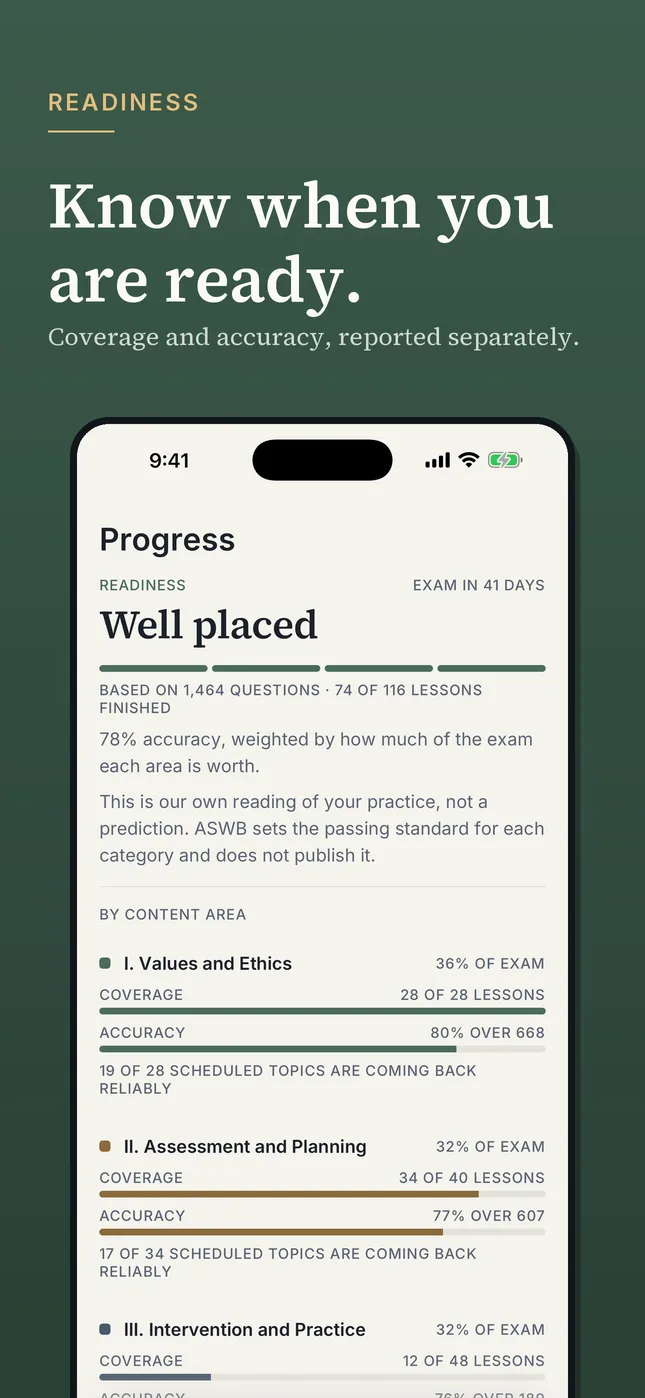
Twelve weeks is a common runway for a working Clinical candidate, and the exam-date setting paces the 116 lessons across whatever span you choose. The Clinical course has 28 lessons in Values and Ethics, 40 in Assessment and Planning and 48 in Intervention and Practice, so a plan that follows the outline looks like this:
- Weeks 1 to 3: Values and Ethics. Take the placement check first, then about 9 lessons a week, answering each lesson's questions the day you read it.
- Weeks 4 to 6: Assessment and Planning. About 13 lessons a week. Sit your first full-length mock at the end of week 6, when you are roughly halfway.
- Weeks 7 to 9: Intervention and Practice. The largest block, at about 16 lessons a week, with a second mock at the end of week 9.
- Weeks 10 to 12: mocks and weak areas. One mock a week, with the days between spent on drills from the weakest area and on the missed-questions queue. Nothing new in the final two days.
The middle weeks are the heavy ones, at two or three lessons a weekday plus their questions. If the schedule shows you falling behind in the first fortnight, move the date then: ASWB lets you reschedule up to 24 hours before your appointment without losing the fee, and a later date is far cheaper than a retake after the 90-day wait.
Knowing when you are ready to book
The app reports readiness as two numbers for each content area, kept apart on purpose: coverage, meaning how many of the lessons you have finished, and accuracy, meaning how often you are right and over how many questions. A blended percentage would hide the case where you are accurate on the half of the outline you have read and unprepared for the rest.
Its readiness target is our own, and the app labels it that way. ASWB sets the passing standard for each category and publishes a range of 66 to 78 correct out of 110, depending on the form you get. Treat a run of mocks above target in all three areas as the signal to book, and a single good score as one good score.
Quick answers
- Is the LCSW exam the same as the ASWB Clinical exam?
- In most states, yes. LCSW is a license title, and the exam most states require for it is the ASWB Clinical exam. Some states use other titles for the same level, such as LICSW, LCSW-C or LISW-CP, so confirm the exam with your board before you book.
- Can I use the app if I am taking the Masters exam first?
- Yes. Choose Masters to start and switch to Clinical when you are ready for it. Each exam keeps its own progress, and the subscription covers all five categories.