What the Masters exam tests
The Masters exam is for master's-level practice: specialized knowledge and advanced skills, normally after an MSW and before the supervised hours a clinical license requires. Depending on the state, it leads to titles such as LMSW, LGSW or LAMSW. In 2025, 73.9% of 20,636 first-time candidates passed (the Masters exam in detail).
Its 2026 outline has 109 statements across three content areas: Values and Ethics at 35% of the exam, Assessment and Planning at 33%, and Intervention and Practice at 32%. The Clinical outline has twelve statements the Masters one does not, and the Masters exam leaves out four that the Bachelors exam tests, so a course built for either neighbor teaches the wrong amount.
The word that decides most Masters questions
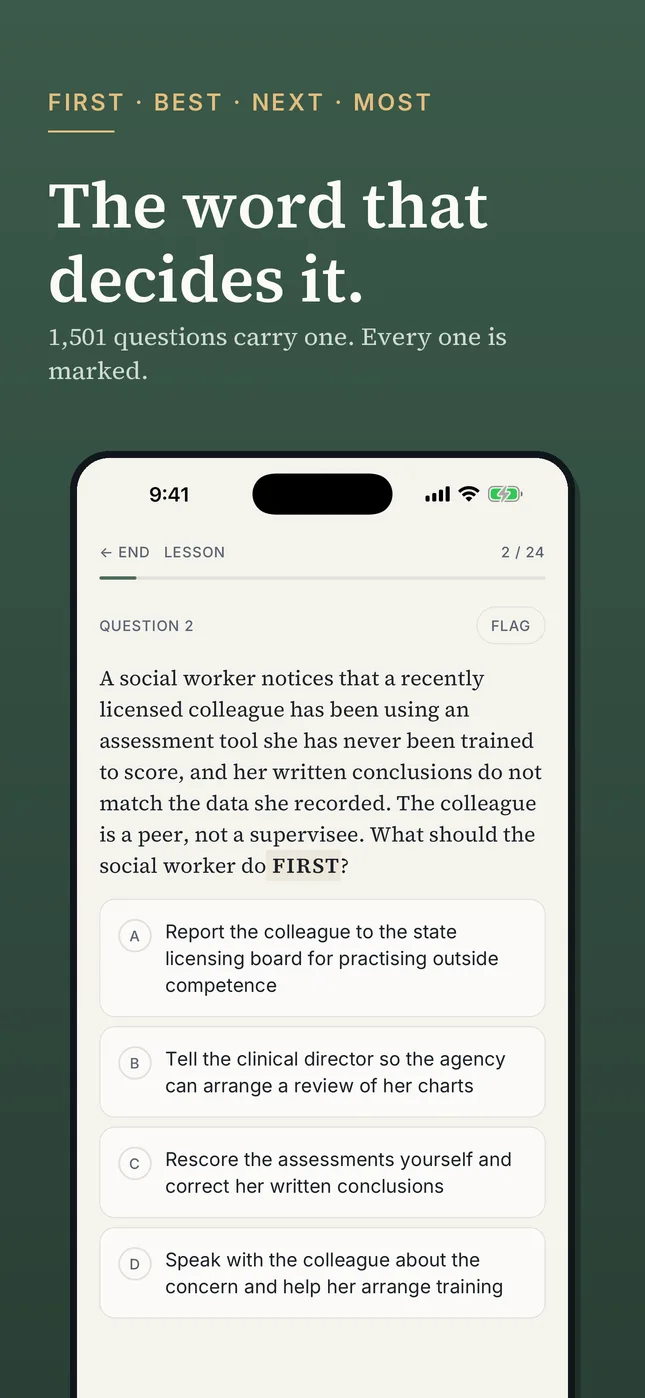
Masters questions are mostly short vignettes that end in a capitalized qualifier: what should the social worker do FIRST, which response is BEST, what is MOST important. Often every option is something a good social worker might do at some point, and the qualifier asks which comes first (why that costs prepared candidates marks).
In our bank 1,501 questions carry a qualifier, and the app marks the word in every one so you cannot read past it. The rationale then explains why that word decides the answer. In the question below, the NASW Code's standard on an incompetent colleague puts the direct conversation first; telling the agency or the board is the second step, offered as the first.
Three options, one fewer distractor
ASWB says its 2026 exams increase the proportion of three-option questions (what that changes). A three-option item is held to the same standard as a four-option one, with one fewer distractor, so each option you rule out carries more of the decision, and each wrong option should be wrong for a reason you can name. The app's three-option drill gives you a run of these, 10, 20 or 40 at a time, to practice the rhythm of eliminating before choosing.
The arithmetic of guessing shifts slightly as well. A blind guess on three options is right a third of the time, against a quarter on four, and ASWB counts an unanswered question as wrong, so never leave one blank. Rule out what you can, choose, flag it, and come back if time allows (how the exam is scored).
Fitting it around a first job
A course of 109 lessons is a lot to read on a small screen, so the app keeps your place: each lesson reopens at the section where you stopped, and the median lesson is about 1,700 words, roughly 8 minutes of reading. Set your exam date and the schedule paces the remaining lessons toward it. Spaced repetition then brings each topic back at intervals, choosing questions on the topic, often ones you have not seen.
A workable weekday rhythm is one lesson section on the way in and a ten-question drill on the way home, with a full-length mock on a weekend morning every week or two in the final month. Our plan for working social workers goes through the hours in more detail.
A ten-week Masters plan
The Masters course has 27 lessons in Values and Ethics, 39 in Assessment and Planning and 43 in Intervention and Practice. At about 14 lessons a week, ten weeks covers it with room for mocks at the end:
- Weeks 1 and 2: Values and Ethics. Placement check first, then the three Values and Ethics chapters, answering each lesson's questions the day you read it.
- Weeks 3 to 5: Assessment and Planning. Sit your first full-length mock at the end of week 5.
- Weeks 6 to 8: Intervention and Practice. A second mock at the end of week 8.
- Weeks 9 and 10: mocks and weak areas. A mock early in each week, drills from the weakest area in between, and nothing new in the final two days.
That is two or three lessons a weekday, plus their questions. If the exam-date schedule shows you slipping in the first fortnight, move the date then, while it costs nothing.
Start with the free chapter
The download includes the whole of Chapter 1, Ethical Principles and Responsibilities: 8 lessons and 192 questions with full rationales. Values and Ethics is the largest content area on the Masters exam at 35%, so the free chapter covers the heaviest-weighted part of your test. A placement check of about 20 questions reads back where you stand across all three content areas before you commit to anything.
Premium opens the rest of the Masters course and the other four exams with it, for US$24.99 a year, or US$2.99 a week with a 3-day free trial. The same chapter is also free to read on this website, starting here.
Quick answers
- Is the LMSW exam the ASWB Masters exam?
- In most states, yes. LMSW is a license title, and the ASWB Masters exam is the test most states require for it. Some states use other titles at this level, such as LGSW or LAMSW, so check the exact requirement with your board.
- How long should I study for the LMSW exam with an app?
- Most candidates plan on two to three months of steady practice, and longer when working full time. Setting your exam date in the app spreads the remaining lessons across the time you have, so you can see in the first week whether the plan fits.