
Why short sessions suit this exam
Two well-replicated findings from learning research do most of the work. Pulling an answer out of memory strengthens it more than rereading the page does, which researchers call the testing effect. Spreading study across days beats putting the same hours into one block, which is the spacing effect. Short daily question sets use both (the research, in more detail).
The ASWB exam adds a reason of its own. Most questions are vignettes about what to do first, and reading them well is a skill, built by repetition (how to read a vignette). Ten careful questions a day train that reading in a way a long weekend session does not.
What works offline in the app
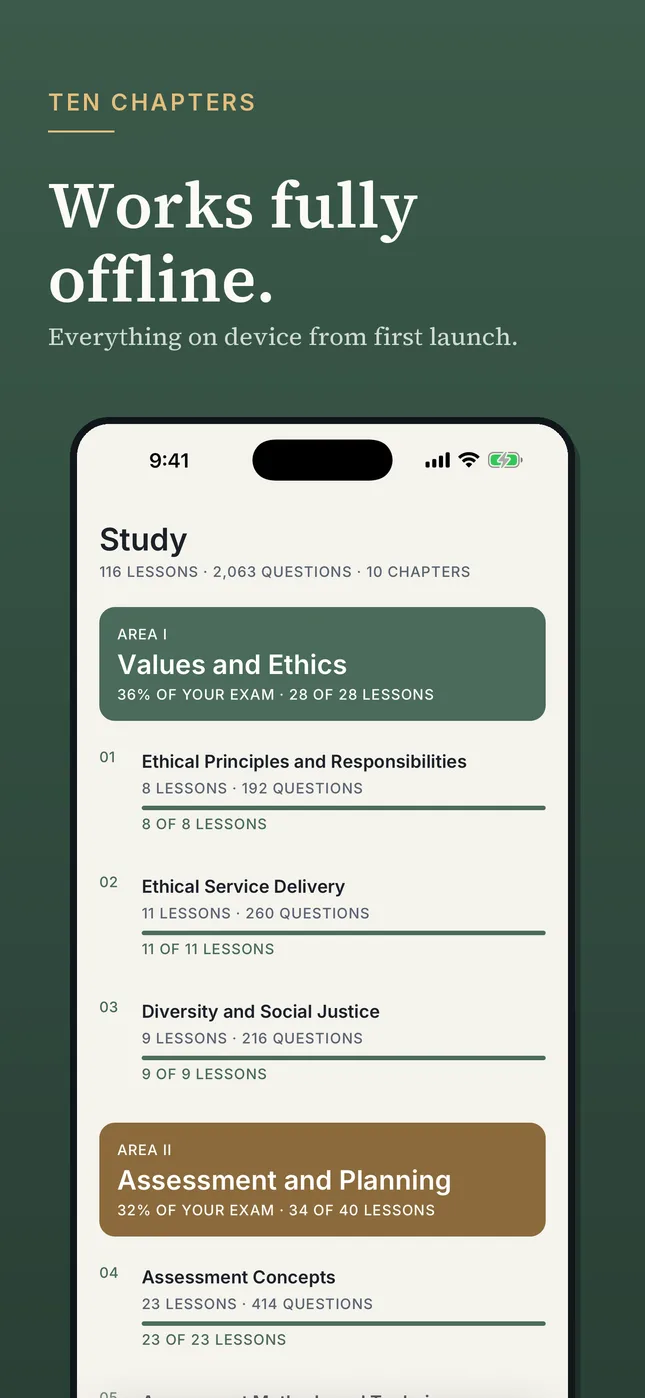
All of it. Every lesson, every question, all 12 mocks for your exam and your progress are on the phone from the first launch, so there is nothing to download before a flight and nothing to lose when the train goes underground. Content updates arrive the next time you are online, without waiting for an app update.
Your place is kept as well. A lesson reopens at the section where you stopped reading, so three minutes at a bus stop is worth opening the app for.
Test it before you depend on it: put the phone in airplane mode and start a drill. It should behave exactly as it does online, rationales included.
Spaced repetition by topic, paced to your exam date
The app schedules review by topic. When a topic comes back, you answer questions on it, often ones you have not seen, so the review tests whether you understand the subject. The progress screen shows how many of your scheduled topics are coming back reliably.
Set your exam date and the schedule paces the remaining lessons toward it. In the first week you can see whether the plan fits the time you have, which is the cheapest moment to move a test date.
A week of phone study, laid out
A week that fits around a full-time job, with the phone doing most of the work:
- Weekdays: two ten-question drills, one on the way in and one on the way home, and a lesson section whenever five spare minutes turn up.
- One weekday evening: twenty minutes on the flagged queue, rereading the rationales that surprised you.
- Saturday or Sunday: one longer block at a desk, either a full-length mock or two or three lessons read straight through.
- One day off. Spacing works partly because the gaps between sessions are real.
Over eight weeks that comes to about 800 questions from the drills alone, each one reviewed properly, before counting the mocks. That is a sound base for most candidates, and how many you actually need depends more on how you review than on the raw count.
What the phone cannot do for you
Some study needs a desk. A full-length mock is four hours of concentration, and although the app runs one in full, it belongs at a table with the phone on Do Not Disturb. The first read of a dense chapter is similar. Use the gaps in the day for questions and review, and keep one longer block each week for the work that needs it (how to sit a mock on your phone).
A 15-minute ASWB study session on your phone
Open a ten-question drill. Choose quick practice, which is weighted across the three content areas the way the exam is, or the weak-areas queue once you have a few days of history.
Answer without looking anything up. Commit to an answer before you check it. A guess you have to defend teaches more than a lookup does.
Read every rationale. Read why each option is right or wrong, including on the questions you got right, because a right answer for the wrong reason fails on the next vignette.
Flag what surprised you. Flag any question whose rationale surprised you. The flagged queue becomes your review list for the weekend.
Finish with one lesson section. If there are minutes left, read the next section of the lesson you are on. The app reopens it at that section next time.
Quick answers
- Can I study for the ASWB exam only on my phone?
- Most of your daily practice can happen on a phone, and the app holds the full course, but sit the full-length mocks in a quiet four-hour block at a desk. The phone is the right tool for daily questions and review; the mocks need exam conditions.
- How many questions a day should I do on an ASWB app?
- Ten to twenty a day with every rationale read is a pace most working candidates can keep up. Twenty careful questions teach more than fifty rushed ones, and the daily habit matters more than any single day's count.